There are several artifacts you will see on your tour of White Hall.
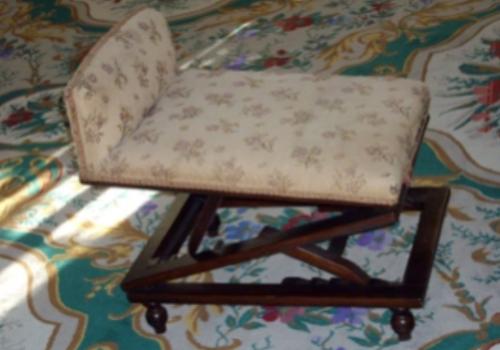
Gout Stool
Guests who visit White Hall often comment on this unusual piece of furniture. Cassius suffered severely from gout and used this stool to relieve the pressure. Gout is a type of arthritis affecting the joints, most of the time in an individual’s legs and feet, which makes walking very difficult and painful.
In his later years, Cassius had his bedroom placed in the library on the first floor of White Hall so he would not have to manage the steps. Although plagued with gout, Cassius was capable of defending himself. One evening he fought off three intruders, killing two of them at the ripe age of 89.
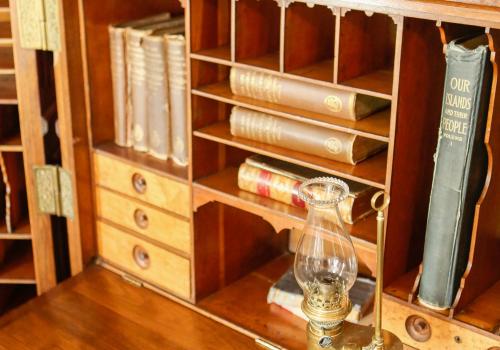
Wooton Patent Desks
For those who liked organization, a Wooton desk was ideal. Originally created by William S. Wooton in 1874 in Indianapolis, this desk was produced at a time when one man could manage a business with one large desk in which all of his records would be filed. The desk’s heyday was in the 1870s when the industrial revolution caused an increase in business activity and more desk and file capacity was required. Sadly, by the 1890s the Wooton became outdated, as typewriters and duplicating machines made smaller desks more popular. The Wooton Desk is a testament of form following function.
Wooton Patent Cabinet Office Secretary Desks came in four different grades: ordinary, standard, extra grade, and superior grade. White Hall has a standard grade desk, which Cassius M. Clay originally owned and then passed on to his son, Brutus Clay.
The Life Memoirs, Writings, and Speeches of Cassius M. Clay Volume I
Although raised by one of the wealthiest landowners and largest slaveholders in Kentucky, Cassius did not approve of the institution of slavery and devoted a great portion of his life to speaking out against the peculiar institution, fighting for the gradual emancipation of slaves. Cassius’ views were not very popular in his hometown; nevertheless he did not let widespread opinion deter him. Clay traveled extensively addressing his opposition to slavery and getting into a number of verbal and physical disputes as a result. Politically, although Clay ran for many appointments, his views regarding slavery were a great deterrent to winning actual posts. One position that he was able to secure was Minister to Russia, appointed by Abraham Lincoln when he took Presidential office.
In his seventies, Cassius chose to pen his Memoirs in an effort to memorialize his actions regarding anti-slavery and politics. The 600 page memoir spans all of Clay’s life up to the mid 1880s. In addition to covering the politics that Clay was involved with, topics within the book are varied and range from Clay’s favorite authors to his defense of an African-American foreman against the Ku Klux Klan. The work also, as the name implies, contains a great deal of Clay’s writings and speeches, as well as various letters.
Clay’s Memoirs, when originally published, were sold by subscription only. Buyers could choose from four different styles ranging in price from five to ten dollars. Although the subscription was to be for two volumes, only one was ever published. Few original copies of the Memoir still exist today. In 1968, a reprinting of the Memoirs that included a reference index was produced in Berea, Kentucky, which coincided with the opening of White Hall State Historic Site. In addition, Negro University Press did a reprinting in 1969, though without an index. Today reprinted copies can be purchased online.
Cassius M. Clay was a man who aspired to greatness, certainly with his ideals concerning freedom, and it is regrettable that he is often overlooked in the pages of history. Oftentimes the legends surrounding the man have taken precedence over the facts. It is therefore heartening that a work exists to prove that Clay, in his own words, was “Quorum - pars fui.” (Translate, “Of them, I was a part.)